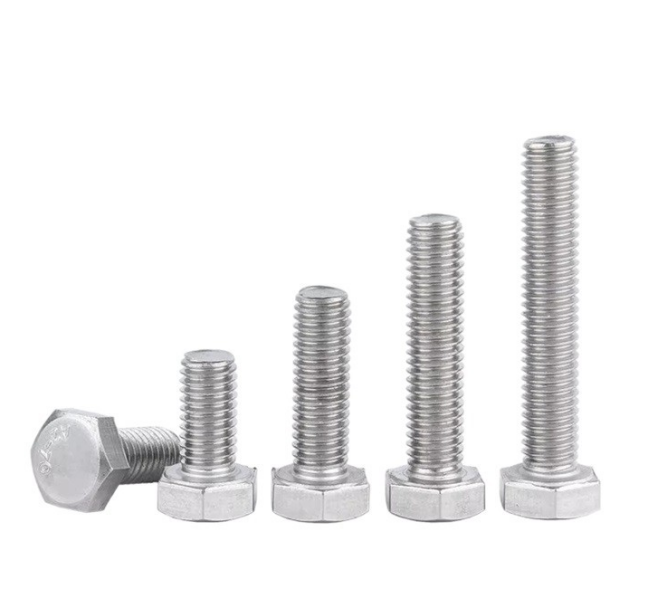
Understanding Hex Bolt Strength Grades and Load Requirements
Tensile and Yield Strength Under Dynamic and Cyclic Loads
Hex bolts in industrial machinery face all sorts of dynamic and cyclic loads. The tensile strength (how much stress they can take before breaking) and yield strength (when they start to deform permanently) play a big role in how reliable these joints stay over time. When bolts get loaded repeatedly, their yield strength becomes really important for resisting fatigue. Take a bolt rated at around 150,000 psi yield strength compared to a standard Grade 5 bolt - the stronger one typically lasts about 30% longer before failing under stress. This matters a lot in places with constant vibration like crushers, compressors, and other rotating equipment. Keeping that initial tension intact is crucial. Tests have shown that critical joints need to hold onto at least 90% of their original preload even after going through 5 million cycles of stress. Failing to account for these dynamic loads puts everything at risk of sudden loosening or complete failure, especially when the direction of stress keeps changing unexpectedly.
Comparing Key Hex Bolt Standards: SAE Grade 5/8, ASTM A325/A490, and Metric 8.8/10.9/12.9
| Standard | Tensile Strength (min) | Yield Strength (min) | Primary Applications |
|---|---|---|---|
| SAE Grade 5 | 120,000 psi | 92,000 psi | General machinery, pumps |
| SAE Grade 8 | 150,000 psi | 130,000 psi | High-stress hydraulic systems |
| ASTM A325 | 120,000 psi | 92,000 psi | Structural steel connections |
| ASTM A490 | 150,000–173,000 psi | 130,000 psi | Critical bridge and seismic joints |
| Metric 8.8 | 800 MPa | 640 MPa | Industrial conveyors |
| Metric 12.9 | 1,220 MPa | 1,080 MPa | Aerospace and precision powertrain components |
SAE grades remain standard for North American mobile and hydraulic equipment, while Metric grades dominate global OEM manufacturing. ASTM standards are mandated in structural applications especially where wind, seismic, or impact loads require controlled ductility and predictable yielding behavior.
When Higher Strength Backfires: Vibration, Relaxation, and Preload Loss in High-Grade Hex Bolts
High strength bolts like Metric 12.9 or ASTM A490 often struggle in joints subjected to constant movement because they don't stretch back as well after being stretched. Tests on shaker tables show these Grade 12.9 bolts actually lose around 25% more tension compared to regular Grade 8.8 bolts when exposed to similar vibrations over time. What happens here is pretty simple physics really the threads experience more stress concentration points and there's also more chance of tiny surface damage occurring between parts that are tightly clamped together. When temperatures fluctuate repeatedly too, things get worse for A490 bolts mounted near furnaces they tend to relax about 40% faster than standard A325 bolts facing the same temperature changes. To deal with all this messiness, engineers have found several workarounds. Flange bolts help spread out the load better across surfaces. Applying those special locking compounds works wonders in areas where parts vibrate more than 10 times per second. And sometimes it makes sense just to go with medium strength bolts coated with elastic materials instead of chasing maximum strength specs when what matters most is how well something holds up against ongoing motion rather than one-time maximum force.
Critical Dimensional and Functional Factors in Hex Bolt Specification
Thread Engagement Strategy: Fully vs. Partially Threaded Hex Bolts for Clamping Integrity
The depth at which threads engage has a major impact on how well fasteners hold together and what kind of failures might occur. Fully threaded hex bolts distribute shear forces evenly across their entire shaft, which makes them great choices for structural applications where shear loads are a concern, think steel frame connections in buildings for instance. Partial thread versions work differently though they focus most of the clamping power right around the bolt head area and beneath the nut. This actually helps prevent loosening from vibrations in machines that spin or move back and forth repeatedly. Experience shows we need at least 1.5 times the bolt's diameter engaged to maintain proper clamping when dealing with repeated loads. So for a standard 12 mm bolt, look for about 18 mm of thread engagement. Going too deep into hard materials can lead to stripping problems while not engaging enough, especially in softer metals like aluminum, results in early pullouts and drops torque holding capability somewhere around 30% short of what specifications recommend. Finding that sweet spot between engagement length and material properties is critical for reliable fastening solutions.
Hex Head Design Benefits: Torque Transmission, Reusability, and Access in Tight Machinery Zones
Hex head designs offer better torque control and work with most standard tools when compared to round or square headed fasteners. The six flat sides allow for tightening and loosening in 60 degree increments, something really important when doing precision assembly work out in the field. ASTM A325 grade hex bolts can be reused over 200 times without the head getting deformed, which means fewer replacements needed down the road and saves money in the long run. Their compact shape makes them ideal for tight spaces found in complex machinery setups. These bolts fit nicely inside gearboxes and other cramped areas where there's barely enough room for a socket wrench, often less than 25 mm clearance. As reported by Machinery Design last year, about 78 percent of engineers choose hex bolts instead of square heads during retrofit projects. They do this mainly because they work with standard wrenches, but also because they need only a 40 degree swing arc to get into those hard to reach mounting spots that are blocked by surrounding components.
Standards Compliance and Application-Specific Hex Bolt Matching
Picking out the correct hex bolt involves looking at what kind of forces it will face, where it'll be installed, and what regulations apply. When dealing with corrosive conditions, particularly ones containing chlorides, go for 316 stainless steel according to either ASTM A193 or ISO 3506-2 standards. For parts subject to constant vibration, Grade 10.9 bolts work best when combined with prevailing torque nuts since they help prevent loosening over time. Food processing equipment needs materials approved by the FDA under 21 CFR 178.3740 plus compliance with NSF/ANSI 51 requirements. Building structures need bolts certified under ASTM A325 or A490 standards, complete with traceable mill test reports, just to meet basic safety requirements for earthquakes and strong winds. Don't forget to check how deep the threads engage (at least one times the nominal diameter is recommended) and whether the bolt head fits properly in its space. Small hex heads can slip easily in hard to reach spots. If working across different countries or wanting better supply chain flexibility, look for fasteners that meet ISO 898-1 specs for strength or follow ASME B18.2.1 guidelines for size and fit.