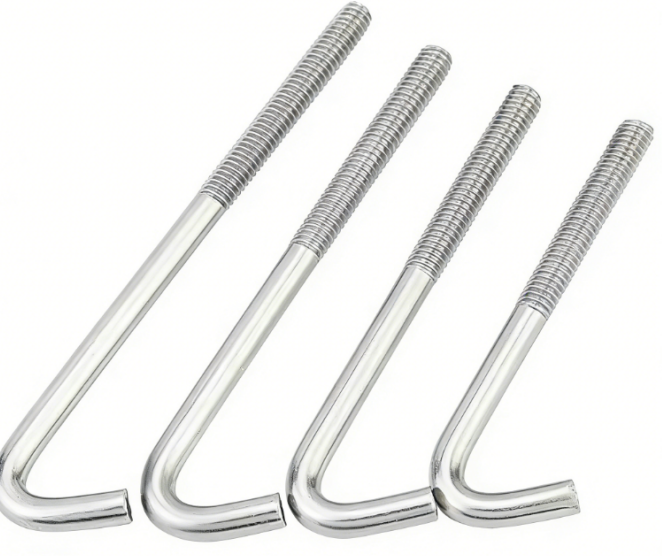
J Bolt Strength Grades and Load Capacity for Hoisting Applications
ASTM A307 vs. ASTM F1554 Grade 55/105: Matching Tensile Strength to Dynamic Hoist Loads
Choosing the right ASTM standard matters a lot when it comes to hoisting safety. The A307 bolts we see around typically handle about 60,000 psi tensile strength, but they really only work well for lighter jobs where things aren't moving much. When buildings get erected dynamically though, contractors turn to F1554 standards instead. Grade 55 gives us roughly 55,000 psi yield strength while Grade 105 jumps up to an impressive 105,000 psi. These higher grades stand up better to those sudden stresses that happen during construction. Anyone who has worked on site knows that Grade 105 bolts resist shock loading about 75% better than their Grade 55 counterparts. This makes a real difference in preventing anchors from slipping loose when cranes start lifting heavy loads, which ultimately means safer operations overall.
Load Derating for Cyclic Uplift: Why 60% of Ultimate Capacity Is the Practical Ceiling in Temporary Hoisting
The constant up and down motion from repeated lifting speeds up fatigue damage in materials. Most industry standards now set limits on how much tension can be applied during temporary lifts. These guidelines come from sources like ACI 318-19 Annex D and are followed by organizations such as PCI and the Precast/Prestressed Concrete Institute. The rule of thumb is to keep working tension at no more than 60% of what the material can ultimately handle. Going over this limit has serious consequences. Every extra 10% beyond the 60% mark actually halves the expected fatigue life. Take a Grade 105 J bolt rated for 20,000 pounds as an example. According to best practices, it should only carry about 12,000 pounds during each lift. This safety margin accounts for all sorts of unpredictable conditions we encounter in actual construction sites. Things like uneven stress distribution in concrete, slight changes in load angles when operating cranes, and sudden gusts of wind all factor into why these conservative limits exist.
Embedment and Hook Design Requirements for Reliable J Bolt Uplift Resistance
Proper installation geometry directly determines whether failure occurs within the concrete or the anchor itself. Two interdependent factors—embedment depth and hook configuration—govern uplift resistance in dynamic hoisting.
Minimum Embedment Depth per ACI 318-19 and PCI Guidelines Under Dynamic Tension
ACI 318-19 sets a baseline requirement of at least 10 times the bolt diameter for static tension applications. But when it comes to temporary hoisting operations, the PCI Design Handbook actually calls for embedment depths that are somewhere between 25 and 40 percent greater. Why? Because those lifting cycles create repeated stresses that standard requirements don't account for. Going deeper helps prevent tiny cracks from forming in the concrete during lifts and also postpones what's known as cone breakout, which happens way too often during hoisting accidents. According to the Structural Safety Journal from last year, about three out of four recorded failures involving hoisting anchors were because of brittle concrete cones breaking away, and almost every single one of these problems stemmed from not having enough embedment depth. Practical experience shows engineers need to check what's going on below the surface too. Things like running into reinforcing bars or dealing with honeycombed concrete areas can cut down the actual usable embedment length by around 30%. When this happens, adjustments need to be made right there on site or sometimes completely different anchoring methods have to be considered instead.
90° vs. 180° Hook Geometry: Impact on Concrete Breakout Strength During Lift-Off
Hook angle dictates how tension forces transfer into the concrete matrix—and critically influences breakout resistance:
- 90° hooks concentrate bearing stress at a single point, increasing localized crushing risk—especially in concrete below 4,000 psi. Anchor Performance Review (2022) found breakout cones initiate 25% faster with 90° hooks versus 180° configurations.
- 180° hooks distribute force across the curved surface, engaging more aggregate interlock and forming wider, more stable failure cones. This design requires 2.1× greater pull-out force, offering essential resilience when shock loads exceed 150% of rated capacity—such as during sudden wind gusts or crane jib slewing.
| Hook Angle | Breakout Cone Radius | Uplift Capacity vs. 90° |
|---|---|---|
| 90° | 2.5× embed depth | Baseline |
| 180° | 3.8× embed depth | +40–60% |
The 180° configuration’s larger engagement zone provides built-in redundancy against crack propagation—a non-negotiable safety margin when lifting precast panels over occupied sites or sensitive infrastructure.
Critical Selection Factors for J Bolts in Hoisting: Concrete Strength, Positioning, and Anchor Integrity
Concrete Compressive Strength (≥3,000 psi) and Its Direct Effect on J Bolt Uplift Capacity
The strength of concrete when compressed plays a huge role in how well J bolts can resist being pulled up. When concrete falls below 3,000 psi, there's a real problem called breakout failure where the tension literally tears a cone shape out of the slab. This isn't just a suggestion either. Contractors need to hit this number if they want anchors to behave predictably when subjected to those sudden forces. Getting this right means proper curing, checking mixes carefully, and running those field tests with cylinders. The thing is, all sorts of factors matter here. If the concrete wasn't placed correctly, or if temperatures were off during curing, or even if moisture levels varied too much, the actual strength on site might drop anywhere between 15% to 25%. And that weak spot right where the hook meets the concrete? That's exactly where problems start showing up.
When to Use — and When to Avoid — J Bolts in Building Hoisting
J bolts remain a proven, cost-effective solution for temporary hoisting of precast concrete panels, steel beams, and similar structural elements—provided embedment depth, hook geometry, and concrete strength comply with ACI 318-19 and PCI guidance. Their simplicity and rapid installation make them ideal for short-duration, controlled-lift scenarios.
However, avoid J bolts for:
- Permanent structural connections, where long-term creep, corrosion, or seismic demands exceed their design envelope;
- High-vibration environments, such as mechanical equipment foundations, where sustained cyclic loading above 60% of ultimate capacity risks progressive anchor degradation;
- Seismic zones, where ductility and energy dissipation requirements favor headed anchors or post-installed systems per ASCE 7-22 and IBC Chapter 17;
- Long-service-life applications, where corrosion resistance is critical—epoxy-coated or stainless-steel alternatives better preserve uplift capacity over decades.
For non-critical temporary lifts in concrete ≥3,000 psi—with verified embedment, 180° hooks, and third-party inspection—J bolts deliver reliable, code-compliant performance.
FAQ
What are the main differences between ASTM A307 and ASTM F1554 Grade 55/105 J bolts?
ASTM A307 bolts are suited for lighter, stationary loads with a tensile strength of about 60,000 psi. For dynamic load applications, ASTM F1554 Grade 55 offers 55,000 psi yield strength, while Grade 105 offers up to 105,000 psi, providing better resistance to shock loads.
Why is the 60% ultimate capacity limit important in temporary hoisting?
The 60% limit helps to minimize fatigue damage and extend the life of the anchor by preventing overstressing during repeated lifts. Exceeding this threshold can halve the fatigue life of the material.
How crucial is the embedment depth in J bolt applications?
Embedment depth is critical for ensuring the anchor doesn’t fail during lifting, where deeper embedment can prevent concrete cracking and cone breakout, thus providing reliable lift performance.
What are the benefits of using 180° hook geometry over 90°?
180° hook geometry provides better force distribution and increased resistance to breakout, especially under shock loads, due to a larger engagement surface with the concrete.
When should J bolts be avoided in construction?
Avoid using J bolts for permanent structures, high-vibration environments, seismic zones, and long-service-life applications due to their limitations with long-term corrosion resistance and dynamic load handling.
Table of Contents
- J Bolt Strength Grades and Load Capacity for Hoisting Applications
- Embedment and Hook Design Requirements for Reliable J Bolt Uplift Resistance
- Critical Selection Factors for J Bolts in Hoisting: Concrete Strength, Positioning, and Anchor Integrity
- When to Use — and When to Avoid — J Bolts in Building Hoisting
- FAQ