Top Allen Bolts for Precision Equipment Applications
Socket Head Cap Bolts: The Standard for High-Accuracy Assemblies
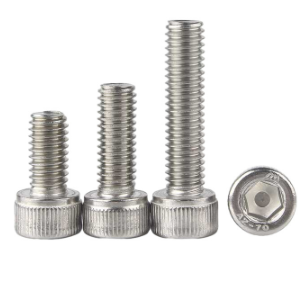
Socket head cap bolts, which have those cylindrical heads with internal hex drives, set the standard when it comes to applications needing high torque but limited space. The fact that these bolts have such a low profile means their heads don't take up much room at all. That makes them perfect for things like optical stages, semiconductor handling systems, and various metrology devices where getting alignment right down to fractions of an inch is basically table stakes nowadays. These bolts can handle some serious stress too. They boast tensile strength ratings reaching up to 170 ksi according to ASTM A574 standards. What does this mean in practice? Well, they won't deform easily even when subjected to vibrations, and will keep their shape stable through all sorts of temperature changes during operation.
Shoulder Bolts and Set Screws for Repeatable Positioning & Alignment
The shoulder bolt design creates those clean, unthreaded cylinder parts needed for really accurate pivot points or bearing surfaces. These are super important in things that rotate constantly, think robotic arms or those precision motion stages used in manufacturing. When manufacturers grind these diameters down to within just 0.0005 inches tolerance, it makes sure everything stays centered and there's no wobble in the shaft connections. According to some research published last year in the Precision Engineering Journal, this kind of tight control cuts down on runout errors by almost 92% when compared to regular old fasteners. And when we pair these bolts with those adjustable set screws that have micrometers built in? Suddenly we can calibrate positions at sub-micron levels over and over again without having to take apart the whole assembly every time.
Flat Head (Countersunk) Socket Screws for Flush, Recessed, and Aesthetic Mounting
Flat head socket screws come in two main types based on their countersink angle: 82 degrees or 90 degrees. These screws sit completely below the surface when installed, giving that smooth finish everyone wants. They really shine in situations where any bumpiness just won't do. Think about wind tunnel models needing perfect laminar airflow, those sliding parts on hospital imaging tables that must move freely, or equipment housings sensitive to electromagnetic interference. For medical applications specifically, anodized aluminum versions help prevent corrosion issues in MRI rooms. Stainless steel options that have been properly passivated work great too since they comply with ISO 14644-1 standards for cleanrooms. Plus these materials stay clean longer because they don't trap particles like other metals might.
Tight-Tolerance Design Requirements for Reliable Allen Bolt Performance
Minimal Head Height and Precision Shoulder Geometry for Clearance-Sensitive Layouts
Just a tiny drop in head height, maybe 1 to 2 mm, makes all the difference when fitting components into those really tight spaces like mini actuators or stacked optical modules. Shoulder bolts that are ground with precision help keep things stable radially. The runout stays well below 0.01 mm most of the time, which means these little vibrations that mess up signals get suppressed in sensitive equipment. Better geometry control leads to much more consistent alignment. Factories report needing to recalibrate their automated testing and assembly systems about 40% less often after making this switch. That kind of improvement adds up over time in both quality and maintenance costs.
Controlled Thread Engagement and ISO/DIN Dimensional Compliance (e.g., ISO 4762 ±0.05 mm)
Getting consistent thread engagement really comes down to following those international standards properly. The ISO 4762 and DIN 912 specs set pretty tight tolerances at around plus or minus 0.05 mm for several key measurements. We're talking about things like how uniform the thread pitch is, whether the shank diameter stays centered, and if the socket depth remains consistent throughout production runs. When manufacturers stick to these specs, they avoid what's called tolerance stacking. This problem happens when small variations accumulate over time and leads to joints coming loose or failing under stress after repeated heating and cooling cycles. The difference in quality shows up in actual results too. Bolts made according to these standards have an impressive 98% success rate when assembled the first time around. That compares to just 74% for regular commercial grade bolts. Better specifications mean fewer scrapped parts, less need for reworking components, and ultimately shorter downtimes on factory lines.
Material and Grade Selection for Allen Bolts in Demanding Environments
Stainless Steel (A2-70, A4-80) vs. Titanium AL-6XN for Cleanroom, Vacuum, and Corrosive Conditions
Choosing the right materials matters a lot when Allen bolts need to work inside vacuum chambers, harsh chemical settings, or those super clean ISO Class 3 through 5 environments. For most regular industrial applications, A2-70 stainless steel gives good protection against corrosion without breaking the bank. Then there's A4-80, which gets an upgrade with added molybdenum content. This version stands up about 30 percent better against chlorides compared to standard A2-70. That extra resistance makes A4-80 the go to choice when bolts are going into salt air locations or near the ocean where corrosion risks are just higher all around.
Titanium AL-6XN really shines when designers need to balance multiple requirements at once - specifically when dealing with weight concerns, corrosion issues, and outgassing problems all at the same time. The material holds up remarkably well against oxidizing acids and even tough saltwater environments. After sitting through those grueling 5,000 hour salt spray tests according to ASTM B117 standards, there's practically no measurable mass loss. What's more, it doesn't release much gas in high vacuum conditions either, meeting the strict ASTM E595 criteria. And interestingly enough, this alloy remains completely non-magnetic, which makes it absolutely essential for applications like MRI room shielding or inside semiconductor manufacturing equipment where magnetic interference would ruin everything. We're talking about a density of around 4.5 grams per cubic centimeter here, which is actually less than half what stainless steel weighs. That kind of lightweight property helps engineers cut down on overall system weight while maintaining structural integrity in precision motion control systems across various industries.
| Property | A2-70 Stainless | A4-80 Stainless | Titanium AL-6XN |
|---|---|---|---|
| Corrosion Resistance | Moderate | High | Exceptional |
| Weight Density | 7.9 g/cm³ | 8.0 g/cm³ | 4.5 g/cm³ |
| Vacuum Suitability | Good | Good | Excellent |
| Cost Factor | 1 | Ã1.5Ã | 3â4Ã |
Titanium definitely comes with a hefty price tag, but when used in harsh environments where materials tend to break down quickly, it can actually save money over time for critical applications. When budgets are tight and conditions aren't too extreme, A4-80 stainless steel still offers pretty good value for what it brings to the table in terms of performance and meeting regulations. Before settling on any material though, it makes sense to check how well it will stand up against whatever chemicals, temperatures, and rules apply specifically to the situation at hand. This step helps avoid costly mistakes down the road.
FAQ Section
What are the key applications for Allen bolts?
Allen bolts are commonly used in precision equipment applications, optical stages, semiconductor handling systems, metrology devices, robotic arms, hospital imaging tables, MRI rooms, and semiconductor manufacturing equipment.
Why are socket head cap bolts preferred for high-accuracy assemblies?
Socket head cap bolts are preferred due to their low profile, high tensile strength, ability to withstand vibrations, and temperature changes, making them ideal for assemblies requiring high torque but limited space.
How do shoulder bolts help in repeatable positioning and alignment?
Shoulder bolts provide clean, unthreaded cylinder parts for accurate pivot points and bearing surfaces, reducing runout errors by improving shaft connection stability.
What materials are best suited for Allen bolts in demanding environments?
Stainless steel A2-70 and A4-80, and Titanium AL-6XN are commonly used in demanding environments due to their corrosion resistance, vacuum suitability, and compliance with various industry standards.