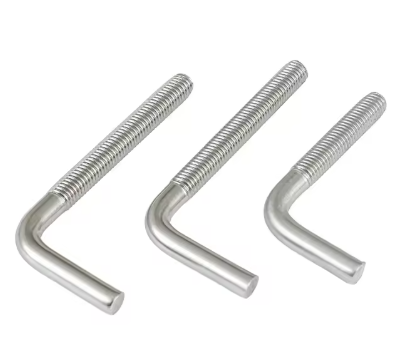
What Is an L Bolt? Geometry, Function, and Structural Advantages
L bolt anatomy: bend angle, leg lengths, thread configuration, and load-path efficiency
The L bolt basically looks like an anchor bent at a right angle, featuring two main parts. One part is the vertical leg with threads for fastening structural components, while the other extends horizontally into concrete foundations. The shape creates better grip against whatever it's attached to, making these bolts much harder to twist or pull out than regular straight or curved anchors. Most manufacturers make them between 4 and 12 inches long, which works well for typical building projects where certain depth requirements must be met. About half to three quarters of the vertical section gets threaded, allowing workers to tighten things down properly using normal nuts. What makes these bolts special is how they handle force distribution. When pressure comes from different directions, the bend helps spread out the stress instead of concentrating it all in one spot. Tests show this design can cut down on stress points by around 40 percent compared to traditional linear anchors, which means fewer failures over time.
Why L bolts outperform J bolts and straight anchors in angle fixing applications
When it comes to angle connections where things like uplift resistance, vibration control, and getting those joints just right matter a lot, L bolts really stand out from the competition. The 90 degree bend gives these bolts about 25 percent more pullout strength compared to J bolts. Why? Because those curved J bolts create stress points when they're subjected to repeated loads over time. Straight anchors work differently too. They depend mostly on how well they stick to whatever surface they're attached to, but L bolts have this extra advantage with their embedded leg that actually fights against rotation. Another big plus is how L bolts stay put during concrete pouring operations. Straight anchors tend to move around quite a bit which can throw off the whole design plan. That's why engineers often go for L bolts when designing structures for earthquake-prone areas. Tests published in engineering journals back this up showing L bolts survive simulated quakes at a rate roughly 30% better than either J bolts or sleeve anchors. Makes sense when you think about what happens during actual seismic events.
Key Selection Criteria for L Bolts in Angle Connections
Matching L Bolt Capacity to Loading Conditions: Shear, Tension, and Combined Forces
Accurate selection begins with rigorous load analysis. L bolts must reliably resist three force types:
- Shear forces, acting parallel to the concrete surface (L bolts provide 30% higher shear capacity than J bolts in angle-fixing configurations, per ASTM E488 structural testing)
- Tension forces, pulling perpendicular to the base material
- Combined loads, where shear and tension act simultaneously—requiring a 25% increase in safety margin over single-load calculations
Industry data indicates 60% of anchor failures stem from underestimating combined loading effects. Always quantify:
- Maximum expected tension (e.g., wind uplift on sill plates or seismic overturning moments)
- Design-level shear (e.g., lateral seismic or wind loads)
- Dynamic amplification factors for vibrating equipment or repetitive service loads
Material, Corrosion Protection, Concrete Strength, and Minimum Embedment Depth Requirements
Four interdependent criteria govern long-term performance and code compliance:
| Factor | Critical Specifications | Failure Risk If Neglected |
|---|---|---|
| Material Grade | ASTM A307 carbon steel (general use) or A304/A316 stainless steel (corrosive or coastal environments) | Brittle fracture under cyclic or low-temperature loading |
| Corrosion Protection | Hot-dip galvanizing per ASTM A153 (minimum 85 µm coating thickness) for outdoor exposure; A316 stainless required within 1 mile of saltwater | Up to 50% reduction in service life in chloride-rich environments |
| Concrete Strength | Minimum 3,000 psi (20.7 MPa), properly cured and crack-controlled | Pullout capacity drops to just 40% of rated value in weaker or cracked concrete |
| Embedment Depth | Minimum 7" (178 mm) for ½" diameter bolts in 3,500 psi concrete | Shear capacity declines by 35% when embedment is reduced to 5" |
Concrete carbonation—advancing at ~1 mm/year in urban settings—further erodes effective embedment depth over time. Leading engineering guidelines recommend adding a 2-inch safety buffer to calculated minimum embedment depths.
Real-World L Bolt Applications: Best Practices and Code Compliance
Sill plate anchoring: IBC/ACI-compliant L bolt sizing, spacing, and uplift resistance
Sill plate anchoring must comply with IBC Section 2308.6 and ACI 318 Appendix D for post-installed anchors. For residential wood-frame construction in high-wind zones (≥110 mph), ½-inch diameter L bolts spaced at 6-foot intervals satisfy prescriptive uplift resistance requirements—provided all installation criteria are met. Key compliance points include:
- Minimum 7-inch embedment into 3,000 psi concrete, verified prior to pour
- Threaded portion fully projecting above the sill plate, paired with an ASTM F436 hardened washer to prevent nut embedment
- Uplift capacity recalculated for site-specific variables: seismic design category, soil classification, and roof diaphragm rigidity
Maintaining a minimum 4-inch edge distance from concrete perimeters is non-negotiable—failure to do so increases risk of concrete breakout and catastrophic pullout during extreme wind events.
Steel-to-concrete angle connections: washer selection, torque control, and edge-distance safety
When attaching structural steel angles to concrete, proper interface mechanics matter a lot. Always put those square plate washers (at least 2 by 2 by quarter inch) under the nuts. They help spread out the clamping force so we don't get these annoying little dents or deformations in the steel base material. The torque specs are pretty important too. Aim for around 70% of what the bolt can handle before it yields. For a half inch Grade 5 bolt, that means getting to about 40 foot pounds using a good quality torque wrench that's been checked recently. Don't forget about edge distances either. Keep at least five times the bolt diameter away from edges. So if working with half inch bolts, stay clear of edges by at least 2.5 inches to avoid cracking the concrete surface. And when dealing with things that move around like machine foundations or factory floors, give everything another tighten after about two days on site. Concrete settles initially, so this second tightening helps maintain that critical clamping pressure over time.
FAQ
What is an L bolt?
An L bolt resembles an anchor bent at a right angle, used in building projects for securing structural components due to its superior grip and force distribution capabilities.
How do L bolts compare to J bolts and straight anchors?
L bolts offer better pullout strength and remain stable during concrete pouring, making them preferable in seismic zones compared to J bolts and straight anchors.
What are the key criteria for selecting L bolts?
L bolts need to be selected based on shear, tension, and combined force resistance, along with material, corrosion protection, concrete strength, and embedment depth.
What are the best practices for using L bolts in real-world applications?
For sill plate anchoring, ensure compliance with IBC and ACI codes, proper embedment, and thread projection. In steel-to-concrete connections, use washers, control torque, and maintain edge distance.