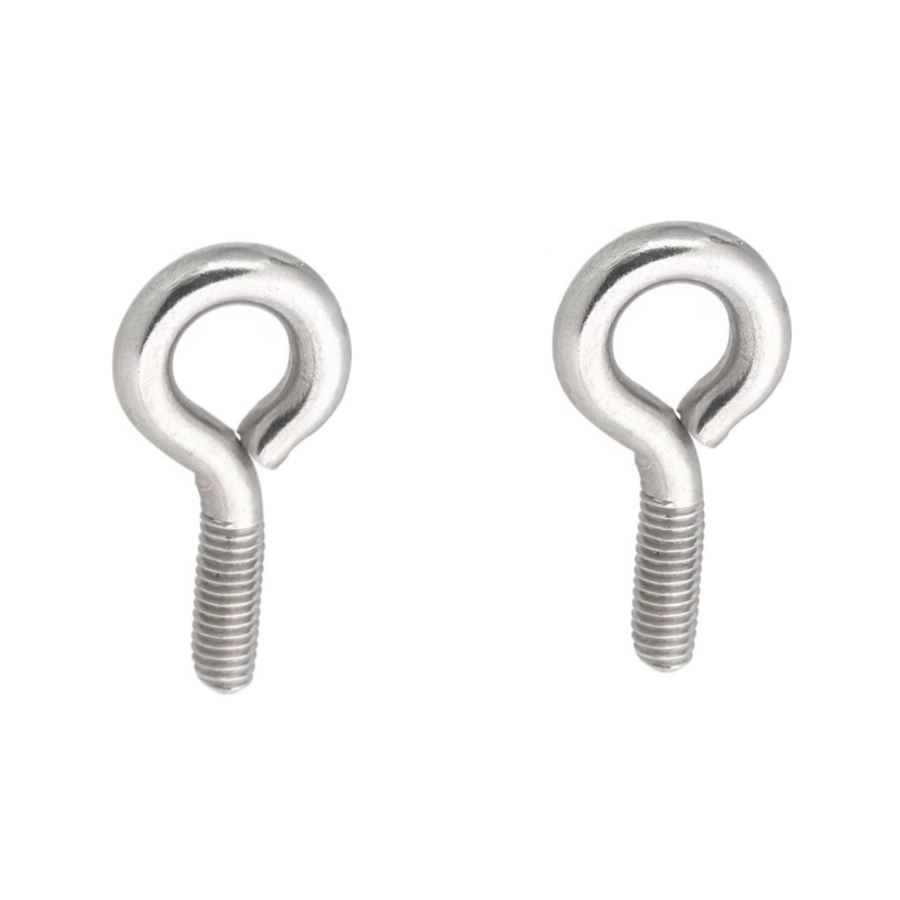
Understanding Working Load Limit (WLL) for Industrial Eye Bolts
WLL vs. Ultimate Breaking Strength: Key Definitions per ASME B18.15 and OSHA 1926.251(c)(2)
Working Load Limit or WLL basically tells us what weight an industrial eye bolt can safely hold during regular operations, not how much it takes to snap. According to those industry standards ASME B18.15 and OSHA 1926.251(c)(2), there needs to be at least a 5 to 1 safety buffer between the actual breaking strength of the bolt (called Ultimate Breaking Strength or UBS) and what gets listed as the working limit. Let's say we have an eye bolt rated for 10,000 pounds when it breaks. That means the safe working load would only be around 2,000 pounds. Why such a big gap? Well, this built-in margin helps prevent accidents during all sorts of lifting tasks where things can get unpredictable. Before grabbing any hardware for the job site, make sure to check the actual WLL marking right on the metal itself. Don't trust just what's written in catalogs or try guessing based on looks alone. We've all seen what happens when people skip this step.
How Material, Shank Diameter, and Forging Quality Determine Base WLL — Data from ASTM F2281 and ISO 3266
Base WLL arises from three interdependent factors:
- Material Grade: Carbon steel (per ASTM F2281) delivers higher base capacity than stainless steel of equivalent dimensions. ISO 3266 Grade 4 carbon steel supports approximately 30% greater load than ISO 3266 Grade 316 stainless steel at identical shank diameters.
- Shank Diameter: Load capacity increases non-linearly with diameter. A 1" diameter eye bolt typically has a vertical WLL of ~10,000 lb; a 2" version reaches ~37,000 lb—nearly four times the capacity despite only doubling the diameter.
- Forging Quality: Drop-forged eye bolts outperform bent-wire or welded alternatives due to optimized grain flow and absence of internal voids. ASTM F2281 testing shows properly forged units sustain up to 50% higher reliability under repeated loading compared to substandard methods.
Angular Loading and Its Critical Impact on Eye Bolt Capacity
The 0°—45°—90° Derating Curve: Quantifying WLL Reduction per ASME B18.15 Annex A
Angular loading fundamentally alters force distribution, introducing bending moments that rapidly degrade effective capacity. ASME B18.15 Annex A defines a standardized derating curve to ensure safe application across common lift angles:
| Load Angle (from vertical) | Permissible WLL Percentage |
|---|---|
| 0° (vertical) | 100% of rated capacity |
| 15° | 80% |
| 45° | 30% |
| ≥90° (side load) | Prohibited |
These percentages reflect exponential increases in bending stress beyond 15°. At 45°, for instance, the eye loop experiences asymmetric force concentration—reducing usable capacity by 70%. Interpolation between anchor points is required for intermediate angles, and third-party verification ensures compliance with this critical standard.
Why Eye Loop Geometry and Lift Angle Interact to Reduce Effective Capacity
Vertical loading engages the full cross-section of the shank evenly. Angular loads, however, introduce lever-arm effects that magnify bending stresses—especially where geometry creates mechanical disadvantage. Two structural realities drive this reduction:
- The circular eye redirects force vectors laterally, increasing torsional strain on the loop and adjacent shank.
- Thinner material at the loop-to-shank junction forms a natural stress riser, particularly vulnerable under off-axis loading.
When loaded at around 45 degrees, something interesting happens with the forces involved. They start moving away from the center of the shank and instead pile up right where the loop meets the shank itself. This area becomes a hot spot for stress buildup and is actually where most field failures tend to occur first. Take a standard half inch eye bolt rated for 4,000 pounds when hanging straight down. Rotate it to 45 degrees and suddenly its strength drops to about 1,200 pounds. The international standards body ISO 3266 does offer some guidance on what shape works best to reduce this problem through proper loop to shank proportions. But let's be honest nobody has found a design yet that completely gets rid of the strength reduction when working at angles.
Ensuring Compliance and Real-World Suitability of Industrial Eye Bolts
ASME B18.15 Certification Requirements and the Role of Third-Party Verification
Industrial eye bolts meant for overhead lifting and structural anchoring need to carry ASME B18.15 certification as a basic requirement. The certification checks if products meet standards through various tests on materials, measurements, and load capacity. Independent inspectors show up unexpectedly at factories to look at around 12 key areas of production quality control. These include things like how well the metal was forged, whether heat treatments were done properly throughout batches, and if proper records exist tracking each component from start to finish. Recent data from last year shows that nearly one out of five eye bolts sampled had incomplete or missing traceability documentation, which highlights why outside audits really matter. Meeting these standards isn't just paperwork either it actually fulfills specific OSHA regulations (section 1926.251(c)(2)) while also plugging holes that might otherwise appear in safety verification processes across different stages of manufacturing.
Matching Eye Bolt Ratings to Application Demands: From Rigging to Permanent Mounting
Selecting the right eye bolt requires matching design features to real-world forces—not just static weight. For rigging, prioritize ASME B18.15-compliant units explicitly rated for angular loading, since capacity drops to 30% at 45° per Annex A. For permanent mounting, performance criteria differ:
- Structural anchoring: Shouldered eye bolts resist vibration-induced loosening and fatigue three times longer than plain-eye variants.
- Corrosive environments: 316 stainless steel maintains 95% of its original WLL after 500 hours of salt-spray exposure (ASTM B117).
- Dynamic loads: Transport and mobile applications require a 5:1 safety margin per ANSI Z359, accounting for shock, acceleration, and inertial forces.
OSHA mandates annual inspections for permanently installed eye bolts, with immediate replacement required upon any visible deformation, thread damage, or corrosion. Always cross-reference manufacturer WLL charts against actual load angle, environmental exposure, and dynamic conditions—not nominal weight alone.
FAQ
What is the difference between Working Load Limit (WLL) and Ultimate Breaking Strength (UBS)?
WLL represents the maximum load that an eye bolt can safely support under normal conditions. UBS is the load at which the eye bolt will fail or break. A safety factor, typically 5:1, is applied between WLL and UBS.
How does the angle of load affect the capacity of an eye bolt?
Angular loading can decrease an eye bolt's capacity due to increased bending stresses. ASME B18.15 Annex A provides a derating curve, showing significant capacity reduction at angles beyond 15°.
Why are independent audits important for industrial eye bolts?
Independent audits ensure that eye bolts meet ASME B18.15 standards, verifying the quality and traceability of materials and processes. They help prevent safety risks due to substandard manufacturing practices.