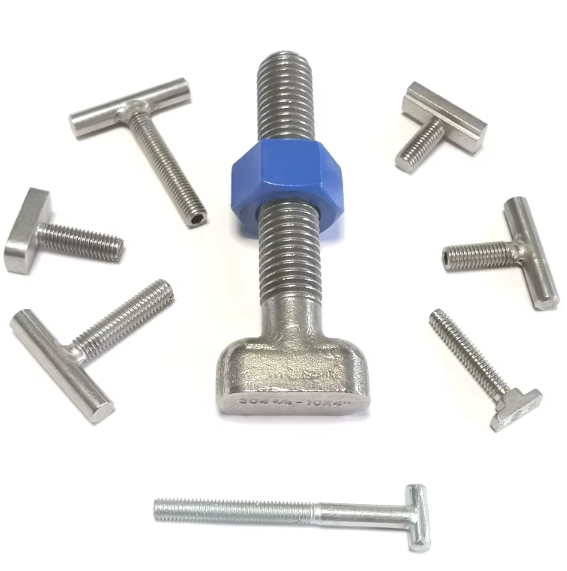
Corrosion Resistance and Grade Selection for Stainless Steel Bolts
304 vs. 316 vs. Specialty Alloys: Matching Stainless Steel Bolt Grades to Environmental Threats
Choosing the right stainless steel bolts starts by understanding what kind of environment they'll face. AISI 304 works well enough for most regular situations indoors or in dry areas, but when there's saltwater or chlorine around, it falls short because it doesn't contain any molybdenum. That makes all the difference. Grade 316 contains about 2 to 3 percent molybdenum which really boosts its ability to resist those pesky pits and cracks that form in corrosive conditions. Because of this, many people go with 316 for things like boat parts, swimming pools, and anything near the ocean. According to NACE International last year, 316 can handle chloride levels five times stronger than what would damage 304 before breaking down. When dealing with harsh chemicals like sulfuric acid, hydrochloric acid, or bleach solutions though, specialty alloys become necessary. Grades such as 254 SMO or AL-6XN offer much better protection thanks to their higher molybdenum content at around 6%, plus added nitrogen that helps them stand up to these aggressive substances.
| Grade | Key Alloy Additions | Max Chloride Tolerance | Typical Applications |
|---|---|---|---|
| 304 | 18% Cr, 8% Ni | 200 ppm | Indoor fixtures, dry climates |
| 316 | 16% Cr, 10% Ni, 2% Mo | 1000 ppm | Marine hardware, pool systems |
| 254 SMO | 20% Cr, 18% Ni, 6% Mo, N | 5000+ ppm | Chemical plants, desalination |
Marine, Chemical, and Food-Grade Applications: How Exposure Dictates Stainless Steel Bolt Choice
The materials we choose depend heavily on what kind of environment they'll face. Take marine environments for instance. Salt air and constant moisture really take their toll on metal components. That's why 316 stainless bolts hold up so much better against stress corrosion cracking compared to regular 304 stainless which tends to break down quickly in these conditions. Now when dealing with harsh chemicals like nitric acid tanks or acetic acid reactors, engineers typically turn to high nickel content alloys such as Hastelloy C276 or go for super duplex grades instead. These materials just handle aggressive chemical attacks much better over time. Food processing plants have different concerns altogether. Regulations matter a lot here since everything needs to be easy to clean and won't contaminate products. The smooth surface of 316 stainless meets those FDA requirements, but some dairy operations actually prefer titanium bolts because they don't risk leaching iron into sensitive products. For parts exposed to extreme heat cycles, like exhaust systems or turbine casings, A286 stainless steel remains strong even at temperatures approaching 700 degrees Celsius. Anyone working with metal components should always check out a good corrosion resistance chart when planning installations, especially if there are potential issues with crevice corrosion or problems from mixing different types of metals together.
Mechanical Strength Requirements for Stainless Steel Bolts
Tensile and Yield Strength Across Key Grades: 304, 316, 17-4 PH, and A286
Tensile strength reflects maximum load capacity before fracture; yield strength indicates the threshold beyond which permanent deformation occurs. These properties vary dramatically across stainless steel bolt grades—and must be matched to functional demands:
- 304: Moderate tensile strength (~70,000–90,000 PSI) with good formability and general corrosion resistance
- 316: Similar mechanical profile to 304 but with markedly improved chloride resistance—ideal when environment, not strength, is the limiting factor
- 17-4 PH: Precipitation-hardened alloy delivering 130,000–160,000 PSI tensile strength and exceptional yield resistance (100,000–120,000 PSI), suited for aerospace, oilfield, and structural applications
- A286: Maintains ~130,000 PSI yield strength at temperatures up to 1300 degrees Fahrenheit—making it indispensable for high-heat fastening in jet engines and power generation
| Grade | Tensile Strength (PSI) | Yield Strength (PSI) | Optimal Use Case |
|---|---|---|---|
| 304 | 70,000–90,000 | 25,000–40,000 | General-purpose hardware |
| 316 | 70,000–90,000 | 25,000–40,000 | Marine/chemical exposure |
| 17-4 PH | 130,000–160,000 | 100,000–120,000 | Structural/aviation loads |
| A286 | 120,000–150,000 | 85,000–110,000 | Extreme heat environments |
Per ASM International standards (2023), 17-4 PH delivers roughly 80% greater load-bearing capacity than standard austenitic grades—underscoring its value in high-stress design.
When Yield Strength Is the Critical Factor in Stainless Steel Bolt Performance
When designing joints, engineers need to focus on yield strength rather than just worrying about preventing fractures. The real concern is whether the joint can resist permanent deformation over time. This matters a lot in equipment that vibrates constantly, pressure vessels with flanged connections, structures designed for earthquake resistance, and systems exposed to repeated temperature changes. Tensile failure happens suddenly and dramatically, while problems related to yield strength develop slowly. With every load cycle, tiny deformations build up until they start affecting how tight the connection stays and compromising seals altogether. According to ASME B16.5 standards, when operational forces go above 90% of what the material can handle before yielding, bolts become much more likely to fail. For pipeline flanges specifically, designers usually aim for a minimum yield strength that's at least 60% of the material's tensile strength so gaskets stay compressed even after many pressure cycles. That's why materials like precipitation-hardened stainless steel 17-4 PH are so valuable here. These alloys offer roughly three times better resistance to yielding compared to regular 304 stainless, which makes all the difference in connections where fatigue and safety are major concerns.
Galling Risk and Material Compatibility with Stainless Steel Bolts
Why Stainless-on-Stainless Fastening Increases Galling Risk—and How to Mitigate It
Galling, which happens when stainless steel threads cold weld together during installation, is one of the main reasons installations fail. Basically what happens is friction creates heat and pressure that wears away the protective chromium oxide coating. Once that layer goes, the reactive base metal underneath gets exposed and starts sticking to other surfaces. The problem gets worse when using identical materials like a 304 bolt with a 304 nut because they have similar hardness levels and chemical compositions. This makes them stick together even more easily. To prevent galling from happening, there are several practical steps manufacturers can take.
- Apply nickel-based anti-seize lubricants during assembly to reduce friction and inhibit adhesion
- Pair dissimilar grades where feasible—e.g., 304 bolts with 316 nuts—to disrupt metallurgical compatibility
- Use controlled torque application and slower tightening speeds to limit heat buildup
- Specify surface-hardened or coated bolts (e.g., Xylan or ceramic coatings) for high-torque applications
- Prefer twelve-point bolt heads over hex designs to distribute torque more evenly and reduce localized stress
Clean, undamaged threads and proper thread engagement depth also play essential roles in preventing galling—especially in maintenance-intensive or high-reliability systems.
Environmental and Operational Conditions Impacting Stainless Steel Bolt Longevity
Chlorides, Temperature Swings, Moisture, and Cyclic Loading: Real-World Degradation Drivers
Four interrelated environmental and operational factors dominate stainless steel bolt degradation in service:
- Chlorides: Accelerate localized corrosion—particularly pitting and crevice attack—in grades lacking sufficient molybdenum. Coastal installations corrode up to three times faster than inland equivalents.
- Thermal cycling: Causes differential expansion between bolt and substrate, generating shear stresses that progressively loosen joints and promote galling during re-torquing.
- Moisture entrapment: Especially in poorly drained assemblies or shielded crevices, moisture enables Stress Corrosion Cracking (SCC)—a brittle, often invisible failure mode prevalent near chemical facilities.
- Cyclic loading: Vibration, pressure pulsation, or repeated thermal expansion/contraction initiates and propagates micro-cracks, culminating in fatigue fracture even below yield thresholds.
Effective mitigation integrates material selection, surface treatment, and maintenance strategy: upgrade to 316 or super-austenitic grades for chloride-rich zones; use anti-seize compounds to accommodate thermal shifts; schedule routine inspections in high-moisture areas; and specify fatigue-resistant alloys like 17-4 PH for dynamically loaded connections.