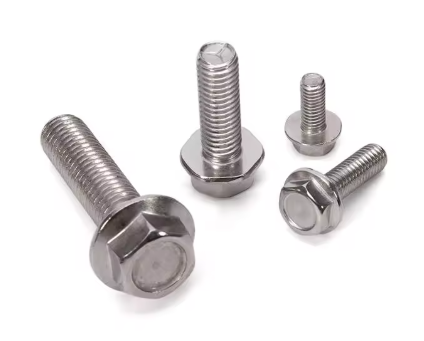
Match Flange Bolt Specifications to Gasket and Flange Face Requirements
Aligning bolt yield strength and length with gasket compression needs (RF, FF, RTJ)
Getting the right flange bolt yield strength and proper length matters a lot when it comes to getting good gasket compression. For raised face (RF) flanges, most of the load gets focused on this small sealing ring area, so stronger bolts are needed to keep pressure even and stop those annoying leaks we all hate in high pressure systems. Flat face (FF) flanges work differently since they spread out the load over the whole gasket surface. That means getting the bolt length just right becomes super important to prevent flange bending issues, especially when working with materials like cast iron that don't bend well at all. Ring type joint (RTJ) flanges create seals through metal gaskets fitting into specially machined grooves. These need bolts strong enough to really seat properly in those grooves, which becomes extra important when dealing with extreme heat or pressure conditions. Going too light on bolt strength can lead to catastrophic gasket failures, but going too heavy might actually damage non metallic gaskets instead. Studies show this can increase leakage problems by anywhere from 15 to 30 percent during repeated cycles according to industry standards.
How flange face geometry affects bolt load distribution and sealing uniformity
The shape of flange faces determines how much bolt force actually gets converted into proper gasket pressure. Raised face (RF) flanges create around 40 to 50 percent more concentrated stress right in that raised area, which means tighter seals can be achieved with fewer bolts overall. But there's a catch they need very careful tightening sequence to prevent those annoying spots where compression isn't uniform across the gasket surface. Flat face (FF) flanges distribute the load more evenly, cutting down on those hotspots of high pressure, so they work pretty well for systems running at lower pressures. Still, if bolts aren't aligned just right during installation, the whole thing falls apart with uneven compression problems. Ring joint (RTJ) flanges take a different approach altogether, using specific groove shapes to physically lock the gasket in place. These require about 25% more initial tightening force compared to RF versions, but when done correctly, they deliver completely leak-free performance even at temperatures over 600 degrees Celsius. Pairing different flange types like RF with FF creates all sorts of headaches because the contact pressure becomes inconsistent everywhere. This violates what ASME B31.3 standards actually intend for these connections, and field experience shows mismatched faces can lead to thermal cycling failures roughly 70% more often than properly matched pairs.
Ensure Dimensional Compatibility: Bolt-Hole Count, Diameter, and Bolt Circle Diameter
Avoiding mismatch between flange standards (ASME B16.5 vs. AWWA C110) and flange bolt layout
When bolt patterns don't match up dimensionally, that's often what causes problems with flange joints failing. Industrial piping standards like ASME B16.5 set specific requirements for how many bolts should be used, what diameter those holes need to be, and where they're positioned around the flange face (this last measurement is called the bolt circle diameter or BCD). Take a standard 12 inch Class 150 flange as an example - according to these specs, we'd expect to find exactly 12 bolts spaced out across a 19.5 inch diameter circle with each hole being precisely 1 inch wide. But look at AWWA C110 instead, which was created specifically for municipal water systems, and suddenly things change. For the same 12 inch size, this standard actually calls for 16 bolts rather than 12. Why? Because water system designers prioritize having extra bolts as a safety margin rather than focusing solely on containing pressure. Mix these different standards together on site and serious issues arise. Bolts just won't line up properly anymore, and the resulting misalignment puts uneven stress on the gasket material. Eventually, this leads to leaks and warped flanges that nobody wants to deal with during maintenance checks.
When there are variations in bolt circle diameters, things get complicated fast. According to ASME B16.5 standards, the BCD actually grows as pressure ratings and pipe sizes increase. But watch out for AWWA C110 specs which can vary by as much as 15%. Take a 4 inch Class 300 ASME flange for example it measures 9.25 inches across the bolt circle. The same size flange following AWWA standards might measure quite differently, creating potential issues when subjected to hydrostatic testing where flange faces could warp or deform. Before buying or installing any components, double check those dimensions carefully. Industry statistics indicate that aligning bolt patterns properly with what the gaskets need can cut down on leaks by around 40%. Makes sense really these small details matter a lot in preventing headaches down the line during maintenance checks.
| Standard | 6" Flange Bolt Pattern | Bolt Hole Count | Bolt Circle Diameter |
|---|---|---|---|
| ASME B16.5 | 3/4" holes | 12 | 13.25" |
| AWWA C110 | 5/8" holes | 16 | 12.75" |
Mismatched patterns accelerate corrosion at bolt holes and induce premature joint leakage—often within months of commissioning.
Choose the Right Flange Bolt Material and Strength Grade per Service Conditions
ASTM A193 B7 vs. A320 L7: Selecting flange bolts for thermal cycling and high-pressure Class 300+ applications
ASTM A193 B7 bolts made from heat treated alloy steel offer exceptional tensile strength along with good resistance to creep deformation. These characteristics make them well suited for applications involving thermal cycling up to around 1000 degrees Fahrenheit and also work well in high pressure systems rated at Class 300 or higher. What makes these bolts stand out is their ability to maintain both strength and toughness through multiple expansion and contraction cycles without losing structural integrity. On the other hand, ASTM A320 L7 bolts are specially formulated for cold environments where temperatures can drop as low as minus 150 degrees Fahrenheit. They keep their ductility and resist fractures even when used in cryogenic storage facilities or during liquefied natural gas transportation operations. Trying to use B7 bolts in extremely cold conditions tends to lead to brittle failure problems. Similarly, putting L7 bolts into hot refinery environments where they face intense stress will result in loss of required strength over time. Getting the right bolt material matched properly to actual operating conditions cuts down on joint failures caused by metal fatigue by approximately 30 percent across various types of critical infrastructure projects.
Risks of over-specifying flange bolt strength: Gasket over-compression and joint leakage
Using bolts that are stronger than needed for the job, like putting grade 10.9 or ASTM A193 B16 bolts into low pressure Class 150 systems, tends to compress gaskets too much. When there's too much force applied, these softer gaskets get squished past what they can handle, which means they start to extrude out from between the flanges, crack, or just flatten permanently. The result? Worse seals and joints that leak more than normal maybe even double the leakage rate. Sometimes when bolts are way too stiff, especially with cast iron or thin carbon steel flanges, the whole face gets warped out of shape. Getting the right bolt strength matters because nobody wants leaks. Most engineers know this already. For systems running at pressures below 300 psi, going with standard strength bolts such as ASTM A193 B7 or A307 Grade B usually works best. These bolts give good enough hold without destroying the gasket material.
Apply Controlled Bolt-Up Procedures to Achieve Reliable Mechanical Sealing
Calculating minimum torque and preload to overcome hydrostatic end force and ensure gasket seating
Getting good mechanical seals relies heavily on proper bolt-up procedures that go beyond simple torque application to include controlled preload as well. When talking about flanges, the bolts need to create enough force to overcome what's called the hydrostatic end force. This is basically the separating force created by internal pressure pushing against the flange surfaces. There also needs to be sufficient residual stress left after installation so the gasket stays properly seated under operating conditions. How do we figure out what this minimum preload should be? A basic calculation works like this: take the internal pressure and multiply it by the area where the gasket sits, then add whatever extra stress is needed for proper gasket seating based on material properties. Getting these numbers right makes all the difference between a leak-proof connection and one that fails prematurely.
When bolts aren't tightened enough, the gasket doesn't get properly seated against the flange surface. On the flip side, going too hard can twist the flange, stretch the bolts beyond their limits, or even tear up the gasket itself. Field technicians know this all too well because industry reports show around 70% of those pesky flange leaks actually come from wrong bolt tightening order rather than faulty parts. Following the staggered cross pattern described in ASME PCC-1 Appendix A helps distribute pressure evenly across the joint while keeping flanges from warping during installation. For high pressure applications where bolts need to handle roughly 50,000 psi stress levels, proper torque specs matter a lot. Using calibrated torque wrenches instead of regular impact guns cuts down on variation in how tight each bolt ends up being by about 30%, especially when paired with lubricants that have known friction properties. And don't forget about checking things again after about four hours of running time. This second round of tightening makes up for the natural settling that happens as gaskets relax and temperatures change, which keeps seals working properly throughout normal operations.
FAQ
What factors should be considered when selecting flange bolts?
Consider the yield strength, length, and material of the flange bolts to ensure they align with the gasket compression needs and operating conditions.
How does flange face geometry impact gasket sealing?
The shape of the flange face affects bolt load distribution and the uniformity of gasket sealing, with RF, FF, and RTJ flanges each requiring different considerations for optimal performance.
What is the importance of dimensional compatibility in flange connections?
Dimensional compatibility ensures that bolt patterns match flange standards, preventing issues like leaks and flange warping during installation and maintenance checks.
Why is it crucial to use the correct flange bolt material and strength grade?
The right material and strength grade prevent failures from metal fatigue under specific service conditions, such as extreme temperature changes or high-pressure environments.
What are the risks of using over-specified flange bolts?
Using overly strong bolts can lead to gasket over-compression, joint leakage, and other mechanical failures.
Why are controlled bolt-up procedures important?
Controlled procedures ensure proper torque and preload are applied, which are essential for achieving a reliable mechanical seal and preventing premature flange failures.
Table of Contents
- Match Flange Bolt Specifications to Gasket and Flange Face Requirements
- Ensure Dimensional Compatibility: Bolt-Hole Count, Diameter, and Bolt Circle Diameter
- Choose the Right Flange Bolt Material and Strength Grade per Service Conditions
- Apply Controlled Bolt-Up Procedures to Achieve Reliable Mechanical Sealing
-
FAQ
- What factors should be considered when selecting flange bolts?
- How does flange face geometry impact gasket sealing?
- What is the importance of dimensional compatibility in flange connections?
- Why is it crucial to use the correct flange bolt material and strength grade?
- What are the risks of using over-specified flange bolts?
- Why are controlled bolt-up procedures important?