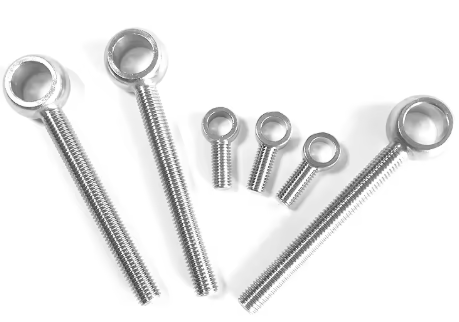
Shouldered Eye Bolts: The Critical Choice for Angular and Heavy Loads
How Off-Axis Loads Reduce Effective Working Load Limit (WLL)
When lifting systems experience angular loading instead of straight vertical forces, the way weight is distributed changes completely. As soon as the load isn't perfectly aligned vertically, side forces start creating bending stress right where the eye bolt connects to its shank. These stresses can actually become three times stronger than what happens during normal straight lifts. Real world tests have found that even a small 15 degree angle reduces the Working Load Limit by about 45%. At 45 degrees off center, this drops all the way down to only 30% of the original capacity. The reason behind this? Every single degree away from perfect alignment turns the lifting force into something that works against itself, applying pressure exactly where the fastener is structurally weakest.
Why the Shoulder Design Prevents Pull-Through and Distributes Bending Stress
Integrated shoulder collars do two main things mechanically speaking. First they keep eye bolts from spinning around when forces get applied, and second they spread out the bending stress so it doesn't concentrate on those weak spots where threads meet metal. When installed properly, these shoulders make sure there's good contact across the whole mounting surface area. This helps prevent what we call point loading, which can warp whatever material we're attaching to or worse yet cause things to come loose entirely. The collar itself is usually wider than the base of the eye bolt, which means any bending forces get directed towards the stronger edges of the collar instead of stressing the delicate thread roots. Field tests show that under angled loads, shouldered designs maintain about 92% thread integrity compared to only 58% for standard bolts without shoulders. Beyond that basic function, the shoulder actually works as a built-in brake of sorts. It stops the shank from rotating back and forth during repeated load cycles something that often leads to failures in actual rigging applications out in the field.
ASTM F2539 Test Data: Shouldered vs. Non-Shouldered Eye Bolts at 30° Load Angle
The ASTM F2539 standard helps measure how much performance drops when looking at a typical industrial angle, about 30 degrees from straight up. When tested this way, eye bolts with shoulders kept around 78 percent of what they can handle vertically. The ones without shoulders? They fell all the way down to just 42 percent capacity. Looking closer at why they failed shows big differences too. Non-shouldered bolts tend to split between the shank and eye part at about half their rated strength. Shouldered models spread out stress more evenly until they actually start to deform permanently. Real world testing backs this up as well. Shouldered eye bolts last roughly three times longer before breaking down when used repeatedly at angles like this in actual applications.
Drop-Forged Eye Bolts: Maximizing Strength and Fatigue Resistance
Grain Flow Alignment in Forging: Why It Boosts Tensile and Dynamic Load Performance
The drop forging process works by shaping hot steel under intense pressure, which causes the internal grain structure to run smoothly from the eye all the way down to the shank area. This continuous grain pattern gets rid of those weak spots that are common in cast or bent metal parts, making them much better at standing up to repeated stress from heavy lifting tasks. When the metal grains actually follow the shape of the part they're supposed to be, the tensile strength goes up somewhere around 15 to maybe even 20 percent, and how well it handles sudden loads also improves quite a bit. That makes forged components especially valuable in places where shocks and vibrations are constant problems, such as when operating cranes on construction sites or working equipment aboard ships at sea.
Grade 8 and ASTM A108 Alloy Steel vs. Cast or Bent Alternatives â Yield Strength Reality Check
| Property | Drop-Forged (ASTM A108) | Cast/Bent Alternatives |
|---|---|---|
| Yield Strength | ⥠140 ksi | ⤠90 ksi |
| Fatigue Life | 2Ã longer | Prone to microfractures |
| Impact Resistance | Retains toughness at -30°C | Brittle below 0°C |
Grade 8 and ASTM A108 high grade alloy steels offer much better consistency in terms of yield strength and density compared to those porous cast options or cold bent materials where the grain structure gets messed up unpredictably. Take ASTM A108 for example it has a minimum yield strength of around 140 ksi, which beats typical bent alternatives by more than half, so there's less chance of permanent deformation when working close to capacity limits. When temperatures drop below freezing, these forged alloys still hold up well against impacts while cast versions become vulnerable to cracking suddenly. That's why engineers really prefer drop forged eye bolts whenever dealing with important installations or situations where temperature fluctuations are part of normal operation.
Correct Installation of Eye Bolts: Ensuring Rated Capacity in Practice
Flush Seating, Thread Engagement, and Alignment â How Errors Cause Up to 35% WLL Loss
When installation goes wrong, it really messes with the structural integrity in three main ways. First off, when parts aren't seated properly, the load distribution gets messed up too. Stress builds up in those spots where there's only partial contact between components. Then there's the issue with threads not engaging enough. If bolts don't have at least one full diameter worth of threading, their tensile strength drops around 35% according to industry tests. That's a big deal. And finally, if things are misaligned by more than 5 degrees, bad stuff happens. The forces start working sideways instead of straight through, which puts way more strain on materials than they're designed for. All these problems together mean stress piles up right at the weakest points - usually the thread roots and where shoulders meet. Over time, this leads to metal fatigue and failures that happen long before anyone would expect based on what's written in safety specs.
Best Practices: Minimum Thread Engagement Rules and Washer Use for Uneven Surfaces
The rule of thumb is to have at least as much thread engagement as the bolt's diameter itself. So if working with a 1 inch eye bolt, make sure there's about 1 inch worth of threads actually gripping into place. When dealing with surfaces that aren't flat or smooth, it's smart to throw in those hardened steel washers underneath. They help spread out the pressure evenly on that whole shoulder area without letting any parts stick out too far. Checking torque regularly keeps things from slowly coming loose when subjected to constant vibrations. And don't forget alignment tools either they're pretty handy for making sure the eye is pointing exactly where the force will be applied. All these steps matter because they protect the weakest spots in the connection the base of the threads and where the shoulder meets the shank of the bolt. Neglecting them can lead to failure down the road when nobody expects it.
Derating Eye Bolts for Angular Loads: From Theory to Field Calculation
When angular forces come into play, they can seriously cut down what an eye bolt is capable of lifting. This safety issue gets missed quite often on job sites despite being critical for proper equipment ratings. What happens when loads aren't straight? The tension plus bending stress doesn't just add up normally it actually combines in ways that make structures weaker than most people would guess. Many folks think if something's at a 45 degree angle, then it loses half its strength. But according to those ASME standards we all need to follow, reality hits harder. At around 50 degrees off vertical, the working load limit drops down to only about 30% of what it would be straight up and down because these stresses pile onto each other so aggressively.
Field derating requires two precise steps:
- Measure the exact load angle using a calibrated inclinometer
- Apply the validated formula:
Adjusted WLL = Vertical WLL à cos(θ)
where θ is the angle in degrees from vertical.
Failure to apply this calculation contributes to 72% of documented rigging failures (Lifting Equipment Engineers Association, 2023), demonstrating how rigorously applied theory translates directly to operational safety. Always cross-check results against manufacturer-specific derating chartsâparticularly for shouldered or forged configurationsâas design variations affect stress distribution and safe angular limits.
FAQ
What is the advantage of using shouldered eye bolts for angular loads?
Shouldered eye bolts are designed to prevent pull-through and distribute bending stress more evenly, maintaining about 92% thread integrity under angled loads compared to standard bolts. This makes them ideal for lifting where loads are applied at angles.
How does forging improve the strength of eye bolts?
Forging aligns the grain flow of the metal continuously from the eye through to the shank, increasing tensile strength by 15% to 20% and improving performance under dynamic loads. This results in better resistance to shocks and vibrations.
What are the recommended practices for installing eye bolts correctly?
Ensure flush seating and minimum thread engagement equal to the bolt's diameter. Use hardened steel washers on uneven surfaces to distribute pressure, and regularly check torque and alignment to prevent loosening due to vibrations.