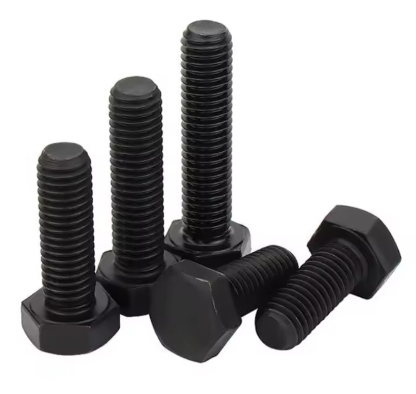
Mechanical Performance: The Foundation of High Strength Bolts Reliability
Tensile and Yield Strength as Core Reliability Indicators
The reliability of high strength bolts comes down to their impressive tensile strength ranging between 800 to 1,200 MPa plus their yield strength which basically tells us how much load they can handle before getting permanently bent or broken. When we look at important structures such as bridges, engineers typically specify ASTM A490 or ISO 12.9 bolts because these grades keep joints intact even when subjected to massive static forces over time. What makes yield strength so important? Well, it allows for some controlled bending instead of catastrophic snap failures. This characteristic becomes absolutely vital in earthquake-prone areas where buildings need to absorb shock through gradual deformation rather than collapsing suddenly during seismic events.
Fatigue Resistance Under Repeated Dynamic Loads
Fatigue is still one of the main reasons why fasteners fail when subjected to repeated loads from sources like wind forces, machine vibrations, or constant traffic impacts. Stronger bolts help prevent these failures using several engineering strategies. First, their threads are designed in a way that spreads out the stress along the entire contact area rather than concentrating it in specific spots. Second, special heat treatments make sure the metal inside stays uniform at a microscopic level. And third, various surface treatments such as shot peening and carefully applied coatings work together to stop cracks from starting in the first place. Take wind turbines as an example they experience something like 100 million load cycles every year. Bolts that pass the endurance tests specified by ASTM F606 standards have shown real world effectiveness against crack growth in these extremely tough operating conditions.
Toughness–Corrosion Balance in Demanding Service Environments
Bolts used in marine environments, chemical processing plants, and offshore installations face a tough challenge - they need to stand up to both brittle fractures and corrosion damage at the same time. A4 stainless steel is one of those advanced materials that meets this requirement head on. The alloy maintains impressive impact strength even when temperatures drop below freezing, which stops sudden failures from happening. At the same time, it forms a protective layer against chloride ions that would otherwise cause stress corrosion cracks. Standard testing procedures back up these claims too. When tested according to ASTM E23 standards, these bolts show impact energy ratings above 27 joules at minus 40 degrees Celsius, proving their ability to handle extreme cold conditions. For corrosion resistance, they pass salt spray tests for over 1,000 hours as per ISO 9227 requirements. These test results aren't just numbers on paper - they mean real world reliability for equipment operating on harsh offshore platforms where maintenance is difficult and downtime costs money.
Material Science and Heat Treatment: Engineering Integrity into High Strength Bolts
Alloy Composition Strategies for Optimal Strength–Toughness Synergy
Getting reliable materials starts with thoughtful alloy composition. When engineers pick elements like chromium, molybdenum, and vanadium, they're not just grabbing random components. These metals work together in ways that matter a lot. Chromium helps build that protective oxide layer on the surface while still keeping things flexible at cold temperatures. Molybdenum does something different but important too it makes the metal harder throughout and spreads out those carbides better, which means longer lasting parts before they break down from repeated stress. And then there's vanadium, which creates these stable carbides that basically hold back grain growth when heated, making the whole thing tougher overall. All this matters most in extreme conditions. Think about wind turbines where bolts get hit with forces over 500 MPa constantly changing direction. If these fasteners aren't designed right, they'll snap suddenly when exposed to sudden temperature changes or heavy impacts, which nobody wants happening halfway through a storm.
| Alloying Element | Primary Function | Impact on Mechanical Properties |
|---|---|---|
| Chromium (Cr) | Corrosion Resistance | – Hardness, – Ductility Loss at Low Temp |
| Molybdenum (Mo) | Hardenability | – Yield Strength, – Fatigue Life |
| Vanadium (V) | Grain Refinement | – Toughness, – Crack Propagation Risk |
Precision Quenching, Tempering, and Hydrogen Embrittlement Control
Heat treatment turns basic metal stock into those essential fasteners that hold everything together. When we do rapid quenching, it creates martensite which makes the metal super strong but also adds problems like brittleness and risk of hydrogen getting trapped inside. Tempering between 400 to 600 degrees Celsius changes things around again. This process takes that brittle martensite and makes it tempered martensite instead, giving back some flexibility without losing all that strength. Another important step after quenching is what they call dehydrogenation baking. Heating parts at 200 degrees for at least eight hours brings down hydrogen levels below 2 parts per million. This matters because hydrogen embrittlement causes about 22% of mysterious bolt failures on offshore platforms according to a report from Offshore Technology in 2022. Getting cooling rates right under 150 degrees per second and managing the atmosphere inside furnaces helps maintain consistent size dimensions and uniform internal structure across batches.
Standards, Testing, and Certification: Validating High Strength Bolts Reliability
Rigorous validation protocols ensure high strength bolts meet critical safety thresholds in structural applications. Independent verification bridges the gap between theoretical performance and real-world reliability.
Non-Destructive and Metallographic Inspection for Microstructural Integrity
Quality control in manufacturing often brings together non-destructive testing techniques with metallographic analysis to check both internal integrity and microscopic structures. For instance, ultrasonic tests spot hidden flaws beneath surfaces while magnetic particle inspection finds cracks that break through to the surface. Metallographic exams look at things like grain patterns, consistency of phases within materials, and how deep decarburization goes these factors can all point toward components failing too soon. What makes this approach so valuable is that metallurgical reviews catch signs of hydrogen embrittlement right from the start, allowing companies to reject questionable batches before they even get installed. Different industries rely on specific methods depending on what matters most for their applications. Aerospace manufacturers typically go with ultrasonics because of its precision, while builders working on bridges turn to magnetic particle inspection for its effectiveness with large structures. Nuclear plants and offshore oil rigs tend to favor metallography since tiny changes in material structure really matter when safety depends on equipment lasting decades.
| Inspection Method | Defects Detected | Industry Application |
|---|---|---|
| Ultrasonic Testing | Internal voids, inclusions | Aerospace, power generation |
| Magnetic Particle | Surface cracks, discontinuities | Bridge construction, heavy machinery |
| Metallographic Analysis | Grain boundary defects, decarburization | Nuclear facilities, offshore platforms |
ASTM A325, A490, and ISO 898-1 Compliance as Industry-Recognized Reliability Benchmarks
Meeting ASTM A325, A490, and ISO 898-1 isn't just about ticking boxes on a checklist. These standards actually form the backbone of how industries maintain reliable, trackable performance in their products. Let's look at what they require: minimum tensile strength specifications like the 1,040 MPa threshold for ISO 898-1 Grade 10.9 bolts, specific yield-to-tensile ratios that must hit at least 90% for Grade 12.9, plus tight control over materials composition, forging processes, and heat treatments. Independent auditors check compliance at every stage of production, starting right from where raw materials come into play all the way through to those final quality tests. The real world impact? Wind farms that specify certified bolts see dramatically fewer problems with structural joints. According to the Renewable Energy Safety Report from last year, these sites experience around 75% fewer incidents than ones using non-certified fasteners.
FAQ
What are high strength bolts?
High strength bolts are fasteners designed to withstand significant loads and stresses without failing. They are often used in critical structures like bridges and buildings to ensure stability and safety under dynamic and static loads.
Why is yield strength important for high strength bolts?
Yield strength is crucial because it indicates the maximum load a bolt can handle without experiencing permanent deformation. This characteristic allows structures to absorb shock without catastrophic failure, especially in earthquake-prone areas.
How do high strength bolts resist fatigue?
High strength bolts resist fatigue by spreading stress across the contact area, using special heat treatments for uniformity, and applying surface treatments to prevent crack initiation. These strategies increase their durability under repeated dynamic loads.
What is the role of material science in high strength bolt design?
Material science plays a critical role in high strength bolt design by selecting and combining alloying elements like chromium, molybdenum, and vanadium to enhance properties such as corrosion resistance, hardness, and toughness.