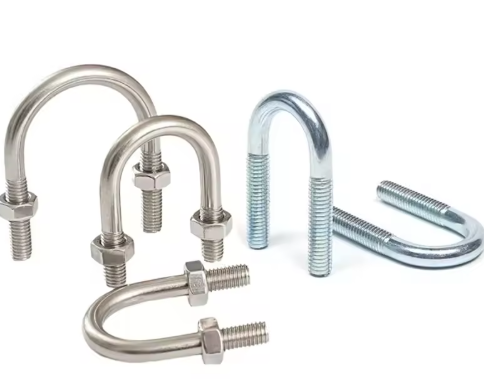
U Bolt Types and Their Functional Applications for Pipe Support
Round Bend vs. Square Bend U Bolts: Matching Geometry to Pipe Shape and Load Distribution
The round bend U bolts have this nice smooth curve that fits right around circular pipes, distributing pressure evenly across the surface and reducing those pesky stress points. The shape actually helps prevent the pipe from getting deformed when there's weight on it, plus it allows for some movement as temperatures change, which makes these bolts great choices for things like heating systems, steam lines, and chilled water installations. Square bend U bolts tell a different story though. Those sharp 90 degree corners create stronger clamping forces on flat surfaces or rectangular shapes like steel beams and duct flanges. Because they're so rigid, these bolts don't let much movement happen at all, which is exactly what's needed in situations where keeping everything in place matters most, think about securing rectangular ducts or setting up earthquake resistant supports. Most engineers will pick between round and square bends depending on what kind of pipe they're working with and how the system needs to behave over time. Round ones go where there might be some flexing required in circular pipes, while square bends stay put nicely on flat surfaces without any shifting.
Standard, Heavy-Duty, and Cushioned U Bolts: Aligning Design with Load, Vibration, and Service Life Requirements
Regular U bolts work fine for simple static loads in dry places where there's no corrosion, which makes them suitable for things like light commercial plumbing jobs or systems with low pressure air. When conditions get tougher though, we need the heavy duty versions made from thicker materials and stronger alloys like ASTM A193-B7. These can handle about two to three times more weight than standard ones, so they're essential for industrial processes involving high pressure steam or fire protection pipes. For areas where vibrations are a problem, especially around pumps, compressors, or other moving machinery, special cushioned U bolts come into play. They have rubber or neoprene sleeves that soak up roughly half of what would otherwise be transferred through the system as shaking. The result? Longer lasting components because the metal doesn't wear out as fast and there's less annoying noise spreading throughout the facility. In really important structures located in earthquake-prone regions, many engineers go one step further by combining both heavy duty construction and these vibration absorbing features. Industry research shows that without proper vibration control, joints fail up to forty percent faster over time.
Critical U Bolt Sizing Parameters: Diameter, Leg Length, and Tolerance Fit
Inside Diameter (ID) Selection: Ensuring Precise Fit Over Pipe OD with Allowable Clearance
When installing a U bolt, the inside diameter needs to line up with the overall size of the pipe plus whatever insulation is present around it. Most installers leave about 1.5 to 3 millimeters extra space beyond what the pipe actually measures. This little bit of room lets things expand when they get hot and handles small movements along the pipe axis without messing up how tight everything stays clamped together. Standards bodies like MSS and ASME have set pretty strict rules here too. For bolts smaller than 50 mm across, they want tolerances within half a millimeter either way so everything stays properly tensioned and doesn't create stress spots somewhere else. Getting this wrong can cause problems down the road. Too much space between components leads to annoying vibrations that wear things down over time. But if there's not enough room, metals might start corroding against each other at those contact points, or softer materials could bend out of shape when loads are applied for long periods.
Leg Length Calculation: Accommodating Pipe Diameter, Insulation, and Mounting Surface Thickness
Leg length determines mechanical stability and load-path efficiency. It must span:
- Pipe outer diameter
- Insulation thickness (if present)
- Mounting surface thickness (e.g., channel, beam, or clevis)
- Minimum thread engagement (㈥1.5Ö nominal bolt diameter)
Generally speaking, the legs need to be at least four times as thick as whatever material we're clamping together to stop them from bending under pressure. Take this scenario for instance: if there's a 50 mm insulated pipe with 20 mm insulation attached to a 10 mm steel beam, then our calculation looks something like this: 50 plus 20 gives us 70, add another 10 for the steel beam makes 80, throw in an extra 15 mm safety margin and we end up needing around 95 mm total leg length. Keep in mind though, building regulations vary quite a bit depending on location. Places prone to earthquakes or strong winds often require longer legs specifically because they want better protection against things tipping over when forces start acting on structures unexpectedly during extreme weather events.
Key Implementation Notes:
- Tolerance Fit: Transition fits (±0.05"“0.1 mm) are recommended for dynamic systems requiring controlled movement; clearance fits (±0.2 mm) suffice for static, non-cycling applications.
- Vibration Mitigation: Increase leg length by 20% in pump or compressor supports to damp harmonic stresses and reduce resonance risk.
- Material Expansion: Stainless steel U bolts require ~15% greater ID clearance than carbon steel equivalents in high-temperature service (>150°C) to accommodate differential thermal expansion.
Material, Coating, and Grade Selection for U Bolts in Diverse Environments
Carbon Steel, Hot-Dip Galvanized, and Stainless Steel (304/316) U Bolts: Corrosion Resistance vs. Cost Trade-Offs
Carbon steel U bolts offer good strength at reasonable prices, with some alloys reaching over 120 ksi tensile strength, which makes them work well for piping systems inside buildings where there's no moisture involved. The downside is these bolts don't resist corrosion on their own so they need protection when used outside or in areas that get washed down regularly. Hot dip galvanizing works by dipping the metal into molten zinc, creating a thick coating that lasts around five to eight times longer than electroplating methods. This makes it a solid choice for things like HVAC units on rooftops or water mains running through cities. When conditions get really harsh though, like near saltwater, in chemical factories, or within food production lines, stainless steel becomes necessary. Grades 304 and 316 stand up better to tough environments. The 316 version contains molybdenum which helps fight off chloride damage especially. But let's face it, stainless steel costs roughly double what galvanized options do, sometimes even triple. So unless the project demands decades of trouble free performance despite higher initial costs, most engineers will stick with the more affordable galvanized solutions instead.
Grade 5 vs. Grade 8 U Bolts: Understanding Yield Strength and Fatigue Performance for Dynamic Pipe Systems
Grade 5 U bolts made from medium carbon steel that has been quenched and tempered typically have a minimum yield strength around 92 ksi which works fine for most static applications where there isn't much movement involved. When we move up to Grade 8 bolts though, these heat treated versions jump all the way to about 130 ksi yield strength. This gives them roughly 30% extra capacity that really matters in situations where things vibrate a lot or go through many cycles of stress. Think about places like pump stations, exhaust systems on turbines, or even those seismic restraint installations. Military tests actually show these Grade 8 bolts can handle about half again as many load cycles before they finally fail compared to lower grades. But here's the catch – when something gets harder it also tends to get more brittle. So installing these requires careful attention to torque specifications to avoid creating stress fractures during assembly. Never just guess at torque values either. Always check what the manufacturer recommends and make sure tools are properly calibrated. Most early failures happen because someone didn't tighten things correctly according to specs.
Installation Best Practices and Load Validation for Long-Term U Bolt Reliability
Getting the installation right and checking everything after is really important for how well U bolts work. Start off by making sure the U bolt sits straight across from the pipe so loads get distributed evenly and there's no weird bending stress happening. When tightening down, use proper torque tools that have been checked recently, and stick close to what the manufacturer says. Going too tight can strip threads or even snap the bolt in half, while not tightening enough just lets things move around and wears out the components faster. In really important applications where failure isn't an option, run some proof load tests at 125% of the working load limit before putting the system into service. This gives peace of mind about structural strength. Regular checks every three months should focus on those telltale signs of wear and tear.
- Corrosion progression, especially in coastal, chemical, or high-humidity zones
- Vibration-induced loosening, signaled by nut rotation or washer deformation
- Cracking at bend radii, often the first sign of cyclic fatigue in dynamic services
Adhere to ASTM F1554 for traceability and retorque fasteners after thermal cycling above 50°C. Field data from industrial maintenance programs shows adherence to these protocols reduces unplanned U bolt failures by 63% compared to informal installation practices.
Frequently Asked Questions (FAQ)
Q: What are the differences between round and square bend U bolts?
A: Round bend U bolts offer a smooth curve ideal for circular pipes, allowing for even pressure distribution and movement. Square bend U bolts, however, offer strong clamping on flat surfaces, suitable for securing rectangular ducts or steel beams.
Q: Why are cushioned U bolts used in installations?
A: Cushioned U bolts are used to absorb vibrations and reduce noise around pumps, compressors, or other moving machinery, increasing the longevity of components.
Q: How important is the correct sizing of a U bolt?
A: Proper sizing of the U bolt, including inside diameter and leg length, ensures mechanical stability and prevents issues such as corrosion and undue stress on pipes.
Q: Which materials are recommended for U bolts in harsh environments?
A: Stainless steel, particularly grades 304 and 316, is recommended for harsh environments such as those near saltwater or within chemical factories due to its excellent corrosion resistance.
Q: How do you ensure the reliability of U bolt installations?
A: Proper installation practices, including the use of calibrated torque tools and regular inspections, are crucial to prevent failures. Additionally, conducting proof load tests and following the manufacturer's recommendations are essential.