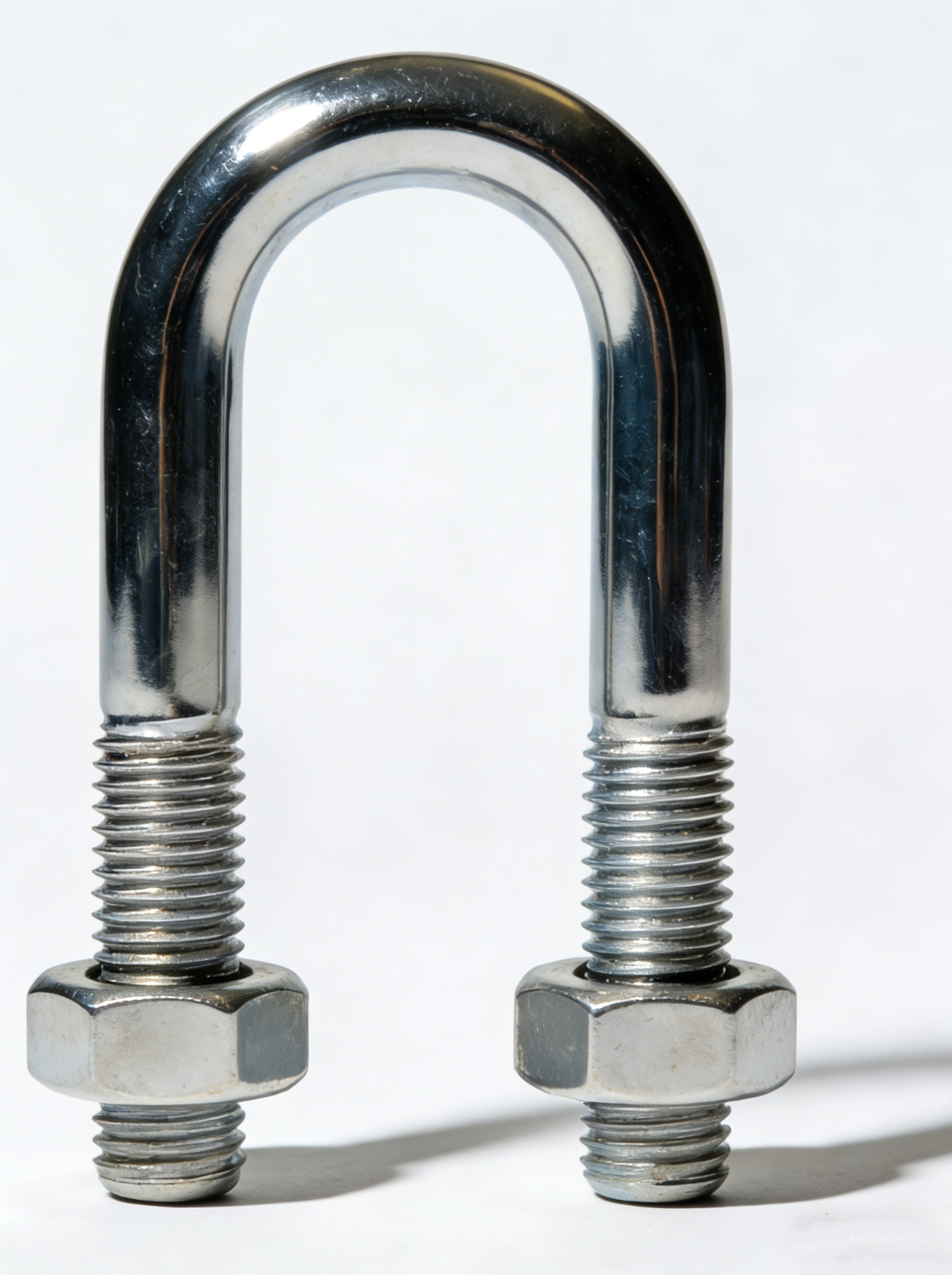
Step-by-Step U Bolt Sizing Process for Pipelines (OD + Wall Thickness + Insulation)
Calculating Effective Pipe Diameter: Accounting for Wall Thickness and Thermal Insulation
Nominal Pipe Size (NPS) doesn’t reflect actual dimensions due to manufacturing variations. Always measure the true Outside Diameter (OD) using calipers or confirm with manufacturer specifications—never rely solely on NPS tables. Then, add twice the insulation thickness to the OD to determine the composite diameter, which governs U-bolt inside width selection. Wall thickness influences load distribution and structural support but does not affect U-bolt clearance requirements.
For example:
- A 2" NPS pipe has an actual OD of 2.375"
- With 0.5" insulation, composite diameter = 2.375" + (2 × 0.5") = 3.375"
| Pipe NPS | Actual OD (in) | Insulation Thickness (in) | Composite Diameter (in) |
|---|---|---|---|
| 1" | 1.315" | 0.3" | 1.915" |
| 2" | 2.375" | 0.5" | 3.375" |
| 4" | 4.500" | 1.0" | 6.500" |
Using Standard U Bolt Dimension Tables: Matching Inside Width to Composite Diameter with Tolerance Guidance
Match the calculated composite diameter to the U-bolt’s inside width using standard dimension tables—then add 1/8"–1/4" tolerance to accommodate thermal expansion, minor misalignment, and installation ease. For a 3.375" composite diameter, select a U-bolt with a 3.5" inside width.
Also verify thread size and bend radius compatibility: typical pairings include 1/2"-13 threads for 2" pipes and 5/8"-11 for larger diameters. Oversizing risks inadequate clamping force and vibration-induced loosening; undersizing compresses insulation, deforms pipe surfaces, or cracks brittle coatings.
| Pipe OD Range | U-Bolt Inside Width | Thread Size |
|---|---|---|
| 1.0"-1.5" | 1.5"-2.0" | 3/8"-16 |
| 2.0"-3.0" | 2.5"-3.5" | 1/2"-13 |
| 3.5"-4.5" | 4.0"-5.0" | 5/8"-11 |
Material, Grade, and Environmental Factors That Impact U Bolt Performance and Safety Margins
Matching U Bolt Material Grade (e.g., ASTM A193 B7, A320 L7) to Corrosion, Temperature, and Load Requirements
U-bolt material selection must align with three operational realities: corrosion exposure, temperature extremes, and mechanical loading. In offshore or chemical service, stainless steels like ASTM A193 B8M (316/L) provide essential resistance to chloride-induced pitting—whereas grade 304 fails prematurely in salt-laden environments. For high-temperature applications above 425°C, alloy steels such as ASTM A193 B7 retain tensile strength far beyond carbon steel’s softening point. In high-vibration settings—like compressor discharge lines—fatigue-resistant grades like ASTM A320 L7 are non-negotiable, as they resist micro-crack propagation under cyclic stress.
These choices directly shape safety margins: mismatched materials can reduce effective load capacity by up to 40%, per ASME B31.4 fatigue analysis guidelines. Always cross-reference environmental conditions against ASTM, ISO, and NACE MR0175/ISO 15156 standards—not just nominal grade labels.
When Backing Plates, Washers, and Torque Specifications Are Non-Negotiable for Structural Integrity
Backing plates and hardened washers are mandatory—not optional—for pipelines operating above 1,000 PSI or subject to dynamic loads (e.g., pulsating flow, seismic activity). Backing plates prevent localized crushing of insulation and distribute clamp force evenly across curved pipe surfaces. Hardened washers eliminate galling during torque application, especially critical with alloy steel bolts prone to seizing under friction.
Torque values must be calibrated to both bolt grade and pipe material. Over-torquing carbon steel U-bolts on ductile iron pipe by just 15% risks thread stripping; under-torquing alloy bolts in vibrating systems invites slippage and fatigue failure. Zinc-plated carbon steel U-bolts, for instance, require ~25% lower torque than uncoated equivalents to avoid hydrogen embrittlement—a failure mode confirmed in NACE RP0287 field investigations. Omitting any of these components undermines the entire support system, increasing risk of joint separation or catastrophic pipe drop.
Compliance, Standards, and Real-World Validation: From BS 3974 to Offshore Pipeline Best Practices
Adherence to recognized standards is foundational—not supplemental—to safe U-bolt design and installation. BS 3974 remains the authoritative reference for pipe support load capacities, material specifications, and performance testing protocols across global industrial sectors. Offshore applications impose stricter demands: API 6A governs wellhead-integrated supports, while NORSOK M-501 mandates multi-layer corrosion protection systems validated for 25-year subsea service life.
Real-world validation now extends beyond compliance checklists. Leading operators require accelerated corrosion testing (e.g., ASTM G85 Annex A5 SO₂-salt spray) simulating decades of exposure—and strain-gauge monitoring during full-cycle pressure testing to verify clamp integrity under operational loads. Field data from the 2023 Offshore Safety Report confirms installations aligned with API RP 14E experience 30% fewer integrity incidents in subsea applications. Regional frameworks remain decisive: North Sea projects mandate NORSOK compliance; Gulf of Mexico operations follow API standards; and Middle East utilities often require additional SASO or ADNOC-specific coating validations. This integrated approach—grounded in codified standards and empirical performance data—ensures U-bolt systems deliver predictable, long-term reliability.
Frequently Asked Questions (FAQs)
Why is Nominal Pipe Size (NPS) not enough to determine U-bolt size?
Nominal Pipe Size (NPS) doesn't reflect actual dimensions due to manufacturing variations. Actual diameter measurements or manufacturer specs are necessary for accurate U-bolt sizing.
How important is the insulation thickness in U-bolt sizing?
Insulation thickness is crucial as it impacts the composite diameter, which determines the appropriate U-bolt inside width.
What happens if a U-bolt is oversized or undersized?
Oversizing can cause inadequate clamping force, while undersizing may compress insulation, deform pipe surfaces, or cause damage to brittle coatings.
Which material grade is suitable for corrosion-resistant U-bolts?
Stainless steels like ASTM A193 B8M (316/L) are ideal for corrosion resistance, especially in environments prone to chloride-induced pitting.
Why are backing plates and washers necessary in U-bolt installations?
Backing plates and washers ensure even force distribution and prevent damage during installation, especially in high-pressure or dynamic load settings.
Table of Contents
- Step-by-Step U Bolt Sizing Process for Pipelines (OD + Wall Thickness + Insulation)
- Material, Grade, and Environmental Factors That Impact U Bolt Performance and Safety Margins
- Compliance, Standards, and Real-World Validation: From BS 3974 to Offshore Pipeline Best Practices
-
Frequently Asked Questions (FAQs)
- Why is Nominal Pipe Size (NPS) not enough to determine U-bolt size?
- How important is the insulation thickness in U-bolt sizing?
- What happens if a U-bolt is oversized or undersized?
- Which material grade is suitable for corrosion-resistant U-bolts?
- Why are backing plates and washers necessary in U-bolt installations?